Showing posts with label Wildwood Manuscripts. Show all posts

Sunday, May 12, 2019

OSE/BX: Cats of the Wildwood (2 of 2)

A continuation of the previous article; five more cats, and some further randomization listings for making them unique. The statistic line for cats, so as to make them useful in OSE, is as follows:

AC 9 [10], HD 1/2 (1hp), Att 1 x Natural Weapons (1d3-2), THAC0 19 [+0], MV 40' (25'), SV 16, ML 5, AL N, XP 5, NA Solitary or 1d3 (as Pets), 1d4+1 (as Feral Cats), 1d8+2 (as Alley Cats Pack).

I think I got the ascending/descending AC right, as well as THAC0 to Base Attack Bonus/To Hit Bonus. I'll compile a good portion of this up later in a pdf, with a revised Dogs of Dolmenwood; so as to allow for more ease of use.

But first, a much belated return to me writing about cats.


6. The Sweeperskit is a boon companion of the tenement house and the villein, as it preys on all manner of household vermin and pesky birds, and also assists in the cleaning of ones hearth. Sweeperskits are narrow things, with bulbous eyes nearly always of blue, and faces coated in a sooty point of black fur. They make use of spindly powerful limbs to climb up inside of chimneys during the day, basking in the latent heat of a previous night's fire, coating their fur in sooty ash, and killing any bird which might attempt to make its nest within. Their name comes from a habit of many a chimney-sweep simply placing such a cat in the chimney of a customer, letting it clear out any debris.

Sweeperskits are kindly to anything warm, and many are used in hospice care for the infirm as a means of keeping up body temperature. The internal temperature of a Sweeperskit is unnaturally high, such that if they were to sit in a vessel of water (which they would not appreciate) they could bring the water to a vague simmer in about five minutes with their violent vibrations. They are very lazy when not provided with a hearth, as such many a gentleman have been known to wear a live one as a stole under their winter coats.


7. The Bellworthy cat is a common breed, often found in the backwater parishes hunting fieldmice and making comfortable dens in floral fields. Notable for their ears which perk up and uniquely fold so as to make the feline appear to be wearing either a papal tiara or a church bell. Bellworthy cats of great pedigree have been found in the portraits of religious leaders for centuries, and more than a few saints have proclaimed them as being the only cat who can sense the fiendish familiars which often assume feline form; and thus by some Divine Grace, Bellworthy cats are unable to be possessed by evil. But such documentation regarding cats being possessed by demons is esoteric at best, and such powers are best left to old maid's tales.

Bellyworthy cats are of capricious and friendly attitude to most; though they are purely outdoor cats and if not allowed to frolic and hunt field vermin they will succumb to depression and overindulge in whatever scrap food they can manage to consume, often resulting in obesity. Bellworthy cats are held in esteem by the Host of Martyrs and the Fraternal Church of the Stone Dove; and any servant of the One True God will likely hold the owner of a well-kept Bellworthy cat as a person of good and honest means.

8. Ogrekit are of a sad reputation, for in truth they are incredibly loving creatures of great intelligence; enough to rival a tipple-drunk Grimalkin if one is being honest. They are round, spud-lie in shape, with narry much to their neck; their limbs are stubby but powerful and their claws always seem to be extended fully. Their face is better described as merely a maw, as if someone had taken the mouth of a lion and placed it unchanged in size upon the much smaller cat. Its eyes are beady, often oblong and uneven, and seem to possess an infinite sadness---as well as eye crusties that are a tarnished, tarry black. They are, according to legend, the cats born into the homes of ogreish and brutish men. Most believe them to be vicious, prone to violence, and the devourers of children and filth.

This is all hogwash, of course. Any owner of an Ogrekit knows them to be kind, loyal, and loving. They are hefty creatures, and their clacking nails upon the floors of a home are notable enough as if to announce to the One True God that the creature is a-coming. A notable trait perhaps where part of their reputation comes from, is how an Ogrekit seems to enjoy the consumption of snails (shells and all) and oozes. Its iron gullet seems to allow it to consume such things in abundance, albeit making the kit both gassy and gurgling for the remainder of the day.
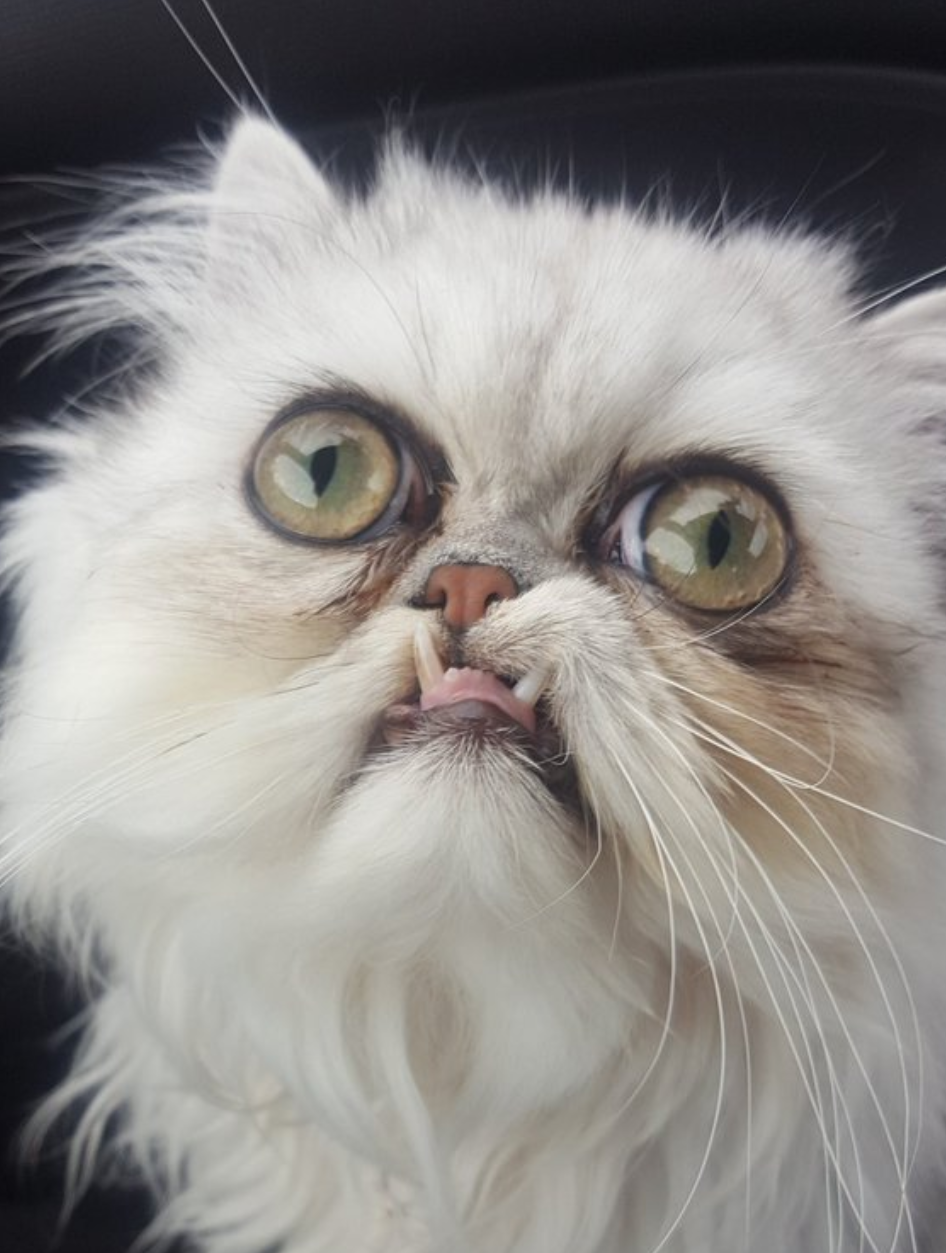
Wilfred the Cat, who is just delightful.


9. Eyewideners may very well be a lesser sort of demon than a proper cat, as they are scabrous, cyclopean, leathery feline-esque creatures which possess an uncanny malice and a penchant for the consumption of spectral energies. Witches and wizards of great potential may conjure an Eyewidener out from whatever dark space within the dreamspace or mythic underworld they originate in; though enough have escaped their masters to occasionally appear in the elf-haunted groves and fetid grottos of the mortal world. They do not yowl or mew, their sound is a hissing cackle; like a tea pot boiling over while a snake is cooked alive inside it.

Eyewideners rest on the heads of their owners, and in mutual slumber the master is revealed terrible cosmic truths; such that upon awakening the owner is able to see invisible creatures for a scant number of minutes; with such creatures appearing as vague misty shapes. Eyewideners, despite their frightening appearance, have been known to be used by witch-finders and charlatans alike in the combating of wicked spirits or the removal of haunts. 

10. Common Wodecat are notably the most common sort of wild cat to be found in the woods and fields of the world, a mish-mashed blend of various breeds which appears otherwise like a normal village cat save for being a bit longer across the torso. Wodecats are renown climbers and can leap a good twenty feet from branch to branch. Arboreal hunters by nature, they feast primarily upon squirrels and small songbirds, whose eggs they enjoy swallowing whole. Their only true rival and competition in their hunts would be owls, whom they view with a vicious rivalry more befitting a dwarf in viewing of goblinoids than in such common creatures.

Wodecats are adequate pets, though often better left to roosting in a barn than being brought into the house proper. They view everything as beneath them, often quite literary, and if not given adequate room to climb and view from above they will cause a ruckus. They will clear out most vermin in a farm within a matter of days, expanding outward until they find a high enough place to perch and wait for more food to fill the gap.


What's unique about my cat? [d20]
1. It has a stubby naked tail, sort of like having a big nipple coming off its rump.
2. It has several additional toes on each foot and enjoys placing those on your face.
3. It gives often painful "love" bites, as if tenderizing your flesh for consumption.
4. It carries baby animals, like rats or possum, upon its back until it decides to kill them.
5. It always seems to be eating bees and hornets...
6. It enjoys licking your overly sensitive bits of skin with an extra sand-papery tongue.
7. It seems to urinate on things you enjoy when it is upset with you.
8. It wakes you up every morning by biting at your nose and screaming.
9. It seems to sway its head and spin when music is played, as if dancing.
10. It never takes its eyes off of a spiritual entity, as if a staring contest might hold it at bay.
11. When fed raw fish it only eats the heads.
12. It enjoys bringing you "treasures," which consist mostly of mutilated vermin.
13. It hates your traveling companions and toots in their general direction.
14. It hates the smell of alcohol and is always tipping over cups and bottles of the stuff.
15. It has notched and mangled ears.
16. Whenever it coughs up a hairball, the hairball seems to be a twitching mass until you blink.
17. It gets into mewling conversations with other cats and looks at you judgingly if you notice.
18. It enjoys screaming at the most unpleasant of times.
19. It likes to rub its head into pungent items, drooling all the while.
20. It constantly "bleps" out its tongue, like it is trying to play a woodpipe.

My cat is... [d12]
1. A lazy lump of a potato, save for when I need a moment to relax and then it has energy...
2. An elegant beast which demands more attention than it really deserves.
3. Not really my cat, it does what it pleases and I just get to witness its greatness by proximity.
4. An adequate bane to tiny crawling things which wish to spoil my house and kit.
5. Good company and soothing to pet after a hard day's work.
6. One of those cats that thinks its a dog. This causes no small amount of chaos.
7. A wild animal and I always seem to forget that. It loves reminding me.
8. More loving than any romantic companion and will never leave me.
9. An ugly little scrotum goblin who I would die for.
10. A snuggling companion who provides me comfort.
11. A maniac creature who will be the death of me.
12. A precious little baby, no matter how fat and old they are.

Next Up: I have a mostly completed Vagabond class I want to give another run-through before I publish, as well as a starting generator for Dolmenwooding purposes. I might put out some character deeds; which are little things that encourage play style which I've used before in games.

Also the Rakehell revision layout is done, it needs a few corrections and I'm putting the pamphlets in it; and then testing a proof; it should be on sale as soon as I get that; hopefully within a week or two. 

Wednesday, April 17, 2019

OSE/BX: Cats of the Wildwood (1 of 2)

A patron requested type of cats, and as such I felt obliged to give cats a full treatment much like a very early article I wrote about Dogs for the Dolmenwood setting. I've recently found some of the hard copy items from my Wildwood Manuscripts project---which were lost when a previous computer caught fire---and so it felt only wise to begin building towards my own workings again. Pending no further calamity in my future, I do desire to get back into publishing; in this case periodical zines.


What follows are five breeds of cats for use in traditional occidental fantasy settings. They'd fit just fine in the Dolmenwood, the Midderlands, Great Lunden, or wherever forests, fields, and posh folk are abound. As cats are generally not assumed to be used as combat companions (unlike a dog might), they are intended to have the following statline:

AC 9, HD 1/2 (1hp), Att 1 x Natural Weapons (1d3-2), THAC0 19, MV 40' (25'), SV 16, ML 5, AL N, XP 5, NA Solitary or 1d3 (as Pets), 1d4+1 (as Feral Cats), 1d8+2 (as Alley Cats Pack).

Expect five more cats before the end of the week, as well as some additional visual randomizers and traits.


1. The Queensown cat is a menacing thing of plump chubby build, stubby legs, folded face, and a malicious desire to rip apart small beautiful things and impale their severed pieces upon any pointed edge it can find. Their mewing is said to sound cruel, like the jovial laughter of a powerful maiden who has just condemned a group of orphans to live out their lives inside an oven. Their fur coat is, however, exquisite, and the Queensown take joy in being festooned with ribbons or being carried about like a trophy. These kinder qualities make the Queensown the perfect cat for nobility, even though many would prefer the symbolism be lost to outside observers. 

They are generally of a nature to accept other, lesser, cats as part of their environment; as they tend to despise other Queensown cats. This complicates things as a Queensown will, generally, only ever seek to copulate with a Queensown; or rather they will only not prey upon the birthed litter that is born from union with another Queensown. They have a tendency to loudly meow when they sense the presence of the poor (how poor exactly, is comparative to the environment they dwell within), and to hiss when exposed to unpleasant smells. 

If left to its own devices, there is a 1-in-6 chance that the mangled impaled creature art created by a Queensown cat may contain a minor reagent, a minute faerie in grave agony, or be viewed as some sort of interesting objet d'art. 

2. The Digging Blathercat is an often feral, burrowing cat of scabrous naked hide, milky eyes, long legs, and radial ears which it folds over its face when engaged in digging. Though more common on the periphery of bogs, they have in recent years become more common in the filthy recesses of the urban sprawl; where they bury themselves in excrement and trash, feasting on the ample rats and vermin that might otherwise congregate therein. They are a talkative breed, honking and mewling to one another in what scholars to believe a relatively complex language used to determine the depth of pits and the stability of tunnels. Their paws have long, almost mole-like claws, with calloused webbing between their toes.

While not the most popular breed for keeping in ones home or around the farm (their burrows can ruin a field as badly as any marmot), they are held kindly by river-dwelling folk. Blathercats are reliable anglers, digging clever burrow traps on the edges of the water which inevitably trap many smell fish for their feeding pleasure; granting them a 2-in-6 chance of successfully hunting fish enough to feed their master when given time enough to dig and hunt. 

They take kindly to more rugged but caring individuals, namely those who can appreciate their often painful grooming rituals. Miners have attempted to make use of them to better sense gas deposits, but the cats do poorly in the cold dankness of a shaft. They disdain clothing for the most part, though can be made to wear outfits of baked clay and fronds, which are tolerable to their flesh.

3. Roosh Tabbies are a common sight on sailing ships, believed to bring good luck to sailors though primarily kept on due to their keen eyesight and playful violence when it comes to vermin. A Roosh Tabby is a long polydactl cat, able to sway with the turning of a boat, snake itself between the legs of sailors in cramped quarters, and using its extra fingers and toes to keep a firm grip on the deck of a ship. Their ears are small and floppy, often kept down to avoid the spray of sea water into their ears proper; one of the few things that seems to put them into a state of rage. They are reliably of calm nature when treated like another member of the crew and given the distance such a position allows for. They hate being held or grabbed, and they have no love for children; who more often than not, lack the proper respect for the cat.

Roosh Tabbies are skilled swimmers, though they only enjoy swimming in very specific situations. They have been observed leaping from high rocks or tree branches into warm, briny waters, swimming in circles and figure eights like a common otter, and then laying half-submerged on the beach. They don't seem to regard other cats as their peers, having much more in common with dogs; who they treat like lesser crewmen in need of a good thumping. 

In the event of someone falling overboard, a Roosh Tabby has been known to heroically leap and dive to save mortal man from the watery depths. In such a situation, a Roosh Tabby is able to move and swim at double speed, and to force itself to carry the drowning as though it were a STR 16 character. Rooshy Tabby are by no means suicidal in their heroics, and when they cannot save someone they tend to fall into deep depressing spells until next time they receive leave at a port.


4. Swaddled Wild Cats are cantankerous forest cats, more at home in the low taiga than they are in any civilized society. They are noted, primarily, for the long flaps of flesh between their forelimbs and rear limbs, which they use to ferment marking pheromones and to swaddle themselves and their young in the colder months. Their faces seem to be in near constant states of panic, their eyes are bugged out and wild, their mouth a mewling snarltoothed grump. They hunt small woodland rodents, birds, though they enjoy the taste of frog more than any other meat. They use a chewed paste of frog meat, left to ferment in their flaps, as a means of wooing mates in the wild; showing their talent as a hunter.

Swaddled Wild Cats can be trained and domesticated, but this will often lead to them putting other, fouler things, in their flaps to ferment. Though all versions possess a terrible stench, off-putting to most, but which can overwhelm nearly any other smell. Hunters have sometimes made use of these cats to help them travel through dangerous territories undetected; though none would call it a pleasant experience.

When domesticated, Swaddled Wild Cats enjoy the company of infants, who they will attempt to swaddle beneath their flaps and to attend to the grooming of. They tend to nestle in the smellier areas of barns or beneath a raised oven, clinging to corners so as to consolidate their heat.


5. Hobbleknobs, aka the Harlot's Knave Cat, aka the Goodie Guardian, is a thin cat with a peculiar knack for mangling the genitals of unshorn men. Depending on whoever is being asked, Hobbleknobs are either blessed servants of the True God who help defend the virtue of maidens; or they are familiars of the most cruel and bleak of witches. Physically they tend to be of greyish coloration, with smooth pelts and innocent childlike eyes. Their tails are short, and when they deign to, Hobbleknobs hobble about on two feet, bowing and lurching like a common drunk. Their forepaws possess two exceptionally sharp claws which come out to their fullest length when walking in this manner, and it is when these variables occur near a naked man with a bountiful pubic region, that it feels compelled to slash, claw, and carry off a penis.

Hobbleknobs universally, hate dwarfs. They seem to sense an innate desire all dwarfs possess to have beards, and this drives a Hobbleknob into a petty, screeching rage. They are kind, somehow, to all women regardless of demeanor or appearance; treating them as something to be assisted against the hirsute masculine. They are a popular pet among the owner of houses of ill repute as well as matron superiors; and there is reason to believe they may be part of the origin for "crazy cat ladies." Of course if a penis-haver does shave in that area, the Hobbleknob sees utterly uninterested in mutilation.

Hobbleknobs deal critical damage to hairy, unshorn men, on a range of 18-20; and they always leave behind a horrifying wound when attacking their favored area of attention. Despite all their violence, it should be noted they are perfectly fine with children and really only have an issue with men who aren't wearing trousers or some sort of covering.

I had to make one when I saw this picture. I had to.


Friday, October 20, 2017

State of the Goblet - October 2017

Just a small update, as things are actually happening. I'm working on a Horror game which I hope to have finished tonight and properly laid out shortly thereafter.

Firstly, the second Chromatic Soup is done. Grab it here! Its a nice slice of Americana goodness, hobos, demons who fell up to earth, and floral hellscapes.

The Wildwood Manuscripts are nearing completion. The goal is to do a zine proper, cover a region, and then cover that region through various seasons of change and threat pack/module based incidents. But first things first is to make a gameable material product, which is what the first issue will be.


Part I: Eight Classes, 200 spells (all designed without levels), Random Generators for Class-Specific Gear, and Class Specific Rumors. Basic rulings spelled out in two pages, this is an OSR game with ascending AC (base 10) and d6-based (Number-in-6) Skills.

Part II: Random Generators for Shoddy, Exquisite, and Mundane Arms, Equipment, and Armour. So each character can have a bit of style to them beyond just "short sword." Plenty of fluff to it, but I think that's useful.

Part III: Given the WWMs are inspired by Beyond the Wall's choice of rulings (on some level, there's some LotFP in there) it felt only right to do some Adventure Party Generators for how you all know one another or have met in the past. Generators are for: The Mercenary Outfit, the Expedition, the Pilgrims, and the Deserters. Different classes have some specific options of fluff to choose. Used to generate starting hirelings/henchmen, and rumors the party knows.

Part IV: The Journey. Finalized "Wanderlust" rules from my first post on the blog, with random generic encounters for each of the roles. This took a bunch of effort to write. It was very tiring to do so. I think it'll be fun to have the encounters/incidents, even if you don't run with the system.

It is long at the moment, it might be trimmed a little. Not much setting to it beyond implications in the classes, but that's sort of the point. Ultimately even if folks don't like my choice of rulings, I hope they can at least use the rulings.

Working with an illustrator on it too. Art order for: the Eight Classes, Weapons, and Armor.
Maybe some spot art if need be. We're trying to cultivate an aesthetic for this, while not making it so colorful that none can afford it being printed.

That being said, may as well be lavish if I can.

I want this out by Late November at the latest. Its about 75% done text-wise, just a matter of making sure it all vibes well and has a semblance of balance. I hate writing spells, but they're important enough.

Depending on how dead I am at that point, it'll likely be a quarterly thing.

Should have a few more things for the blog shortly, but I'm busy at the moment. I'll also be participating in this year's Santicore. Should be fun.

- Brian.

Saturday, September 23, 2017

Wildwood Manuscripts: The Elf [WIP]

The Elf [Fluff]
Upon the first rising of the sun upon the world, the Elfs emerged; naked save for starlight and hedonistic beyond belief. They sang in tune with ancient wicked gods, and from their lips and glistening flesh emerged all things of nature. Trees of thorns, flowers that breathed forth dark dreams, and blackest mold sprouted from their steps. The world was a magical place in those ancient days, but God had to grace the world with his presence; and as such the Elfs fell to damnations most dire.

Prince Nuada was hella cool.
The ordaining of the world shattered the least of the Elfs into miasmic clouds of fey dust, with the strongest of their kind being forced to align to the new ways in which the world spun. Spring, Summer, Autumn and Winter became their blood, and when one was in concordance with the season of the world they could almost taste the sensations of the primal world. But it would always be stolen away as the seasons shifted to the next, providing a new high for some and a wretched low for all others.


When Elf first came into interaction with Man, they saw the flame imperishable of God’s gift; the immortal soul; and in their jealousy engaged in petty skirmishes. Man and Elf warred at times, married at others, and to this modern era many an Elf is still known to pilfer a child from its crib so as to attempt theft of that soul and its power. As reaction to their thefts, God made silver and loyal steel their bane; so that man might better combat them. The most ancient of Elfs remember ancient cities of silver most true, now abandoned to the wilds due to their painful touch.


Elfs are strange, by mortal standards, though to Troll or Dwarf they are not altogether odd. They never need to sleep when their season has begun, making them pursuit hunters worthy of great fear and respect. They can see the lingering remnants of the magical world that was, noticing lies and obscured things as though no obfuscation could take place. They lack a soul, much like a Dwarf or a Troll; which is to say that fiends and the holy hosts of Heaven care little for them beyond use as catspaws and pawns. However unlike other primordial beings they are bound to the cycles of fate, to the seasons, and in seasons antithetical to their own they find themselves greatly diminished.

I love the Lorwyn Elf aesthetic.

Why should one adventure with an elf? Well, one should consider that an elf is an immortal spirit that is likely well-learned in ancient lore. They are strong in the use of magic, with powers granted to them on their season of alignment. They can, for a period of time, work without need of rest; and their eyes see strange truths where others see only lies. It should also be considered that despite their tenuous history with humanity, most of the bigotry aimed against them is little more than folktales to the average human. An elf is always something most folks will wish to meet, if only for rumors of the ancient world and to see their glamorous beings.


The Elf
Hit Dice: d6
Initiative Bonus: +1


Saving Throws
Class Feature
Level
Experience
Enchantment
Substance
Geas
Dragon Spume
Ensorcellment
Spells Known
1
0
12
11
12
17
14
2
2
2,500
12
11
12
17
14
+1
3
5,000
12
11
12
16
13
+1
4
10,000
12
11
12
16
13
+1
5
20,000
12
11
12
14
11
+1
6
40,000
10
9
10
14
11
+1
7
80,000
10
9
10
13
10
+1
8
150,000
10
9
10
13
10
+1
9
300,000
10
9
10
11
8
+1
10
450,000
10
9
10
11
8
+1


The Elf [Mechanics]


Silver Sickness & Weakness to Cold Iron: As elfs are the quintessential fey, they are cursed by God to be sickened at the touch of silver and iron. When an elf touches an item of silver their skin will take on a sickened pallor like a drowned corpse, becoming slimy to the touch for the remainder of the day. Elfs also suffer double-damage when struck with iron weapons.


Sights Unseen: Elfs know how the world looked in ancient times and as such illusions and falsehoods are easily discerned. An Elf can find hidden doors and things, see invisible creatures, and see magic naturally at a rate of 3-in-6. They may also detect lies and mistruths at the same rate, though they cannot discern the truth at a success; merely that someone is attempt to trick them.


Bound Fey: All Elfs are bound to one of the four seasons, though they may change which season they are aligned to by way of painful transformation or entering a portal into the fairylands during a season other than their own. During their season, an Elf does not need to sleep to recover health and they need not eat either (save for their own enjoyment). During the season antithetical to their own (Spring and Autumn, Summer and Winter) they are diminished, suffering Disadvantage on a single roll per day at the GM’s request.


Spells: An Elf knows a number of spells as determined by their level plus their Wisdom modifier (meaning an Elf with a Wisdom modifier of +1 would begin with 3 Spells.) The spells an Elf may know are determined by what season the Elf belongs to, as well as a generic list of spells any Elf may know. An Elf must change their spells to the next season whenever they undergo a seasonal change. An Elf may research / memorize spells as per the usual rules, though they may not cast spells if the world is in a season antithetical to the season the spell is from (such as casting a Summer spell in Winter, even if memorized.) An Elf may cast a spell as many times as they desire until it fails, at which point they must wait until the dawn of the next day to cast that spell again.Elfs do not suffer any additional penalty when they fail a spell-casting roll.


Elf Seasons: An Elf changes seasons by way of a painful shedding of their flesh, doing so either by choice when the natural world changes seasons, by going into the fairylands, or once every generation without choice. An Elf who changes seasons must roll a Save vs Enchantment, on a failure losing the ability to cast spells for 1d4 hours per level.


d4 Result
Elf Season
1
Spring
2
Summer
3
Autumn
4
Winter

Spells of Spring
  1. Stormsworn - So long as the caster keeps their eyes on the sky, they and a number of allies equal to their level, suffer no ill misfortune from the weather. Downpours seem only to mist upon them, gale winds barely ruffle their clothing, and blasts of air do not send their arrows in incorrect directions. This spell lasts a number of hours equal to the caster’s level.
  2. Riddle of the Heart - By placing their finger into a drink or item of food, the caster may implant a number of impulses into the head of the victim equal to their level. These impulses will not cause the target to act outside its own safety, but they can cause them to do foolish things or act on hidden urges the caster is aware of. The impulses must be chosen at the time of casting, and the victim may Save vs Enchantment if the impulse would cause them trouble; though even on a success they are not aware they’ve been bewitched.
  3. Rejuvenating Touch - If the caster places a hand over the heart and mouth of their target, they may immediately heal that target an amount equal to a roll of the target’s Hit Dice + the caster’s level. Wounds bind themselves shut, scars fade, and serious injuries can stabilize though will not heal fully without proper medical aid.
  4. Wood Warp - The caster may shape wood with their hands as though it were soft clay. They may order wood to splinter, shatter, rot, or blossom with new life.
  5. Bloom - The caster beckons forth nearby plant life to blossom into life. Flowers bloom, trees become fruitful, and vines become thick as ropes. Creatures who are plant-like in origin gain an additional HD of health, but suffer disadvantage to act against the caster. The caster may cement such creatures into the ground by demanding their roots to do so.
  6. Spring Showers - The caster may with a simple nod of their head, cause stormclouds to gather and rain to fall. The rain will fall for a number of hours equal to the caster’s level. If the caster makes a Charisma check, they may order lightning to strike from these clouds, dealing 1d12+Level damage per check. This spell may only be cast outside.
  7. Renewal - The caster may with a touch repair an object back to its original state. This will fix damaged armor, a hole in a boat, or a notched sword; but it cannot return enchantments back to such items.
  8. Dawn - The caster invokes the dawn, granting a number of creatures equal to the caster’s level a chance to make Save vs Enchantment, awakening anyone within a hex that the caster desires, and / or forcing restless spirits back into their haunts. The effects of this spell are immediate, though any spirit disturbed by the spell may manifest again after a number of hours equal to the caster’s level.
  9. Dove of the Morning - The caster conjures forth into their hands a dove, which will relay a message in the caster’s voice to a target within a number of hexes equal to the caster’s level. The dove is made of cloud stuff and cannot be caught or harmed.
  10. Rites of Hospitality - With a subtle glance, the caster may charm a victim into acting in the best interest of the party; provided no violence will knowingly come to someone in the victim’s immediate charge. The victim remains charmed for a number of minutes equal to the caster’s level, after which they are immune to this spell for 1d4 days.
  11. Doldrums - The caster yawns and the target begins complaining about boredom and dissatisfaction for a number of minutes equal to the caster’s level, during which time they will skirt their duties in favor of complaints. The victim can Save vs Enchantment to halve the effect.
  12. Ecstasy - A flirtatious gesture causes a number of targets equal to the caster’s level to be stunned by waves of pleasure and hedonistic delight. The targets are stunned for 1d4 rounds, during which they stumble about as though drunk and aroused.


Spells of Summer
  1. Sunlight - By outstretching a hand, the caster can bring forth a globe of golden sunlight which illuminates everything within vision as though it were daylight for a number of minutes equal to the caster’s level. Creatures weakened or harmed by sunlight suffer the usual effects. The globe is warm to the touch but utterly intangible for other purposes.
  2. Cloud Visage - The caster may project themselves as a paredolic figure in the clouds, allowing them to see from a bird’s eye view for a number of hexes equal to 2d10+Level. They cannot see in great detail, but would be able to easily notice burning cities or a camp fire’s light at night. Those the caster has given a token or service to can be spoken to by the caster should they be looking up at the sky. The spell lasts 1d6 minutes.
  3. Screaming Mandrake - The caster can turn a root vegetable into a shrieking terrible bogun which upon being touched by any mortal hands will begin screaming for a number of rounds equal to the caster’s level. The scream deals 1d4 damage per round to all who can hear it, and anyone who holds it is deafened for 1d4 days. After the plant is done screaming, it shrivels up to look like a shrunken head.
  4. Hawk’s Eye - The caster grants perfect vision to a target, allowing them to roll with advantage when attacking or looking for something. This spell lasts for a number of minutes equal to the caster’s level.
  5. Summer of Youth - The caster imbues youth upon their target, granting them advantage on Strength, Dexterity and Constitution rolls for a number of hours equal to the caster’s level. During this time they take upon a more youthful appearance, as though they were in the prime of their lives. Casting this spell upon a young adult or anyone who has yet to reach their prime reduces their age by 1d4 years.
  6. Ferocity - The caster pounds on their chest, rousing the fury of their compatriots. A number of allies equal to the caster’s level may increase the damage their melee attacks deal by one dice increment (d4 to d6, d6 to d8, et cetera.) This bonus exists for however many rounds the caster pounds on their chest, though they may shift to another loud act of percussion if their hands are needed. Upon ending this drumming, those affected must Save vs Sorcery or become fatigued.
  7. Beatific Sun - This spell must be cast at any time other than night. The caster imbues sunlight into the target, permeating their flesh and soul. The target is able to see in darkness for a number of hours equal to the caster’s level, is warm to the touch, is immune to the damages of fire, and their face appears to be featureless and golden. After the spell wears off, the target falls limp and cold for 1d4 minutes.
  8. Baleful Polymorph - The caster may curse the target, shifting one aspect of their person (head, hands, legs, arms, genitals) into an aspect resembling an animal. This curse lasts a number of days equal to the caster’s level. The caster may sacrifice a spell per day to keep the curse going for an additional d6 days per daily sacrifice.
  9. Breathless - The caster shuts their mouth firmly, and doesn’t need to breathe for a number of hours equal to their level. They may cast the spell on others by placing an object they own into the mouth of the target, so long as their mouth remains closed they too do not need to breathe.
  10. Heat Shimmer - The caster holds a hand outstretched and the heat within 20 feet around the caster becomes balmy and dizzying. Those who enter that space with intent to harm the caster suffer disadvantage on attacks due to the heat, and if they remain within that space for more than 1d4 rounds, they become fatigued.
  11. Exhalation of Purity - By exhaling sharply, the caster blows away any gasses, fogs, miasma, dust, smoke, or poison cloud within 20 feet. The caster may choose instead to inhale these dangers, making a Constitution check, which upon passing allows the caster to exhale the content safely within a number of rounds equal to their level. If the check is failed, they suffer the ramifications of their foolishness.
  12. Night Songs - By humming a low tune, the caster may enter the spirit world, leaving their body in a catatonic state of constant low chanting. While in the spirit world, the caster may only be harmed by means that would harm a spirit. If this spell is cast at night, the caster is possessed by starlight and does not fall into a catatonic state. They may interact with the spirit world as though it were the physical world, and anything they wield is similarly touched by starlight and able to harm spiritual entities with a bonus to damage equal to the caster’s level.


Spells of Autumn
  1. Blight - Plants and organic matter within 20 feet of the caster begin to rot, wilts, and sprouts with fungi. Plant creatures take Ld10 damage, while normal creatures take 1d4+L damage.
  2. Creeping Sickness - The caster makes a beckoning motion and the victim slowly has the health sapped from them for a number of hours equal to the caster’s level. Each hour the victim takes 1d4 damage and must Save vs Enchantment or become sickened for a number of days equal to the caster’s level. Upon becoming sick, the victim no longer suffers damage from the spell.
  3. Harvest Moon - This spell must be cast during the evening or at night. A number of targets equal to the caster’s level may work through the night without need for rest, provided they are performing a labour, march or a hunt. They cannot suffer fatigue during this time.
  4. Wild Hunt - The target of this spell grows a pair of thorned antlers upon their head and their eyes shift into those of a wolf. For a number of nights equal to the caster’s level, the target is able to sense the presence of prey animals and individuals who are feeling a sense of fear or dread. If the target kills a sensed creatures, it gains a +1 bonus to damage for the following the night. If the antlers are ripped from the head of the target, there is a 1-in-20 chance the target will transform into a wolf for the remainder of the spell’s effects.
  5. Dread Whispers - The caster whispers low under their breath and all animals within a 50 feet must pass a Morale check or become shaken, cowed, or otherwise cautious and fearful of the caster.
  6. Elf King’s Pursuit - The caster becomes semi-intangible as though they were a ghost, and they may travel at inhuman speed (a number of hexes per hour equal to their level); but only in pursuit of a victim, quarry, or someone they intend to harm. They cannot enter houses, cities, or blessed places while under this spell. This spell lasts a number of hours equal to the caster’s level.
  7. Harvest Rations - The caster is able to make a single serving of rations feed a number of individuals equal to the caster’s level. The rations bloat inside the stomach of those who eat it, and eating this way more than twice in a row requires a Save vs Substance to avoid being sickened.
  8. Blood Moon - This spell must be cast at night. The caster must inflict damage equal to their level with a bladed instrument, but in doing so the moon in the sky turns red. Spirits are able to be harmed by physical weapons, predatory animals within the caster’s hex may now speak, and anyone who attacks in an aggressive stance does an additional +1d4 damage. This spell lasts a number of hours equal to the caster or until dawn rises.
  9. Sin-Eater’s Touch - The caster may transfer a number of diseases, parasites, or illnesses equal to their level form one individual to another, though the effects of this last only for a number of hours equal to the caster’s level before the contagions return to their original source.
  10. Spirit Mask - The caster may conjure forth a number of wooden masks equal to their level. Those who wear the mask may see ghosts and spirits, and be assumed by those entities to be ghosts or spirits at a rate of 4-in-6. These masks rot away by the following dawn.
  11. Black Hound - The caster howls, and in the distance a horrific howl is barked in response. Mortal creatures must make a Morale check or become shaken. Those who flee are hounded by a shadowy beast who will attack and deal 1d8 damage a number of times equal to the caster’s level before vanishing.
  12. Cloak of Autumn - The caster bestows a conjured cloak of leaves upon a target, which lasts for a number of hours equal to the caster’s level. Whosoever wears this cloak can hide in wilderness at a rate of 4-in-6 and move without making a sound while in the woods.


Spells of Winter
  1. Form of Frost - The target becomes an intangible bluster of snow and air, able to chill things, fly, and effectively vanish for a number of minutes equal to the caster’s level.
  2. Heat Theft - The caster steals away warmth from a target by way of a touch, fatiguing them after one round, and dealing 1d4+Level damage for each additional round that touch is maintained.
  3. Hibernal Warmth - The caster may touch an individual and put them into a comatose state for 1d4 hours, during which they heal as though they were resting comfortable for an equal number of days. The elements do not harm the individual under this spell.
  4. Chill Steel -  The caster may painfully chill metal, forcing those hit with the spell to either drop what metal they are holding or suffer 1d8 + Level in damage.
  5. Winter’s Flesh - The target’s skin becomes pale as alabaster and they suffer no need for warmth for a number of hours equal to 1d8+Level.
  6. Icicles - The caster may conjure forth magical a number of icicles equal to their level which deal 2d4 damage when touched. The icicles may be used as weapons and will drop from heights if ordered to.
  7. Northern Winds - The caster exhales a powerful gust of chilling air, knocking back enemies a number of yards equal to the caster’s level. If the victims are not wearing winterized clothing, they suffer 1d8+Level in damage.
  8. Boreal Songs - The air around the caster begins blowing strangely and harsh whispers speak on the wind. Those affected by the spell suffer disadvantage while attacking, as though they were fighting in darkness. The songs speak to them of their deaths.
  9. Thin the Air - The caster inhales a sharp breath and the air within the immediate area becomes ungodly thin. Those affected by the spell must make a CON save or suffer disadvantage on attacks due to dizziness.
  10. Mantle of Winter - The caster imbues the essence of Winter upon a target, granting them immunity to cold and frost, and a 1d8 freezing breath weapon. The target also suffers weakness to fire, which deals double damage. The effect lasts a number of hours equal to the caster’s level.
  11. Shatterfrost - The caster chills the soul of a weapon or armor to horrific brittleness. If the weapon rolls a critical hit or a critical failure it shatters into a million pieces. If the armor is struck with a critical hit it shatters and deals 1d10+Level damage to the victim. This affects items of metal, bone, stone or wood.
  12. Shield of Ice - The caster causes the air to freeze solid when a blow might strike them, forming a shield that blocks the caster’s level in damage, for 1d4 rounds.


Generic Elf Spells [Any Season May Have These]

  1. Faerie Fire - A beautiful fire erupts around the target, making them very apparent and obvious. The target cannot hide, even through magical means, and suffers irritating itches for a number of rounds equal to the caster’s level, reducing their AC by 2. If the target is wearing loyal iron or silver armor, the faerie fire will not illuminate such parts.
  2. Sleep - The caster closes their eyes and takes a breath, outstretching a hand. A number of victims equal to their level become drowsy and begin to sleep. If left undisturbed for a turn, they will lay down and slump off to sleep for a number of minutes equal to the caster’s level in d4s.
  3. Delusions of Pride - The caster shakes their hands wildly and the victim begins to realize how much better than everyone else they are. The victim will not fail any morale checks for the remainder of the battle that are made to flee, but they must make morale checks to follow anyone else’s orders. If the victim is a target of a mind-affecting spell, they gain advantage on Saves against it.
  4. Glamour - The caster may alter their appearance to be that of a beautiful, attractive, glamorous or handsome version of their own self. The glamour lasts a number of hours equal to the caster’s level, but always fades away at midnight.
  5. Loosen Bonds - The caster grumbles under their breath and bonds begin to loosen, granting a bonus equal to the caster’s level on any Dexterity check to slip out of bonds. This spell may target as many people as the caster names while mumbling under their breath.
  6. Curse of Foolishness - The caster snaps their fingers and the target becomes befuddled and nonsensical for a number of rounds equal to the caster’s level. They can speak only in nonsense, appear off-kilter and drunk, and generally act as the opposite of their usual demeanour in a comedically exaggerated way.
  7. Veil of Night - The caster holds aloft their arms and the world appears as though it is in twilight for all who have seen the caster. Those who were gazing directly upon the caster attack and act as though blinded, with disadvantage, for a number of rounds equal to the caster’s level. If the caster lowers their arms, the veil of night is removed. This spell cannot be cast at night.
  8. Wild Speech - The caster may speak the language of beasts, animal, birds, and plants; allowing them to convey complex ideas to such individuals; though they cannot necessarily hear a response from these entities, they will generally act in the interest of the caster if it aligns with their own desires. Bribery is encouraged.
  9. Debauchery - The caster falls into a state of hedonistic glee, becoming immune to spells that might otherwise alter their mind or purpose, but suffering the effects of being the life of a party. The caster cannot cast spells while debauched, attracts 1d6 per level in revellers from the nearby wilderness or town (of all ages, species, and levels of sapience). The debauchery lasts a number of hours equal to the caster’s level, after which the caster is fatigued, hungover, and has suffered an ill-effect of carousing.
  10. Theft of Youth - The caster steals a number of d4 equal to their level in years from the target, causing them to age horrifically. This theft lasts one day per caster level, and anyone who dies as a resulted of being aged to death crumbles into a pile of dust.
  11. Soul Theft - The caster rips the soul from a helpless or dying human, granting them currency in fiendish bargaining. A soul may empower a spell adding an additional d8+Level of the victim in damage to the spell.
  12. Curse of Atavism - The caster curses the victim to the intelligence of a beast for a number of rounds equal to the caster’s level.

A gelfling is fine too.
Hoof. Just gotta finish up the base Magic-User class, finish cleaning up spells, and adjust all the classes to be more BtW in power and I'm done. The fluff charts and such are fun to make, and will come later.

On spell design, I'm a fan of utility within specificity. Magic should be weird, it should require gestures and words, and you should get better with it over time. Thus I like spells to be advanced by a class's levels, rather than having a cast level situation. I also like "cast til you fail" type stuff. The Priest can cast if they fail, but risk God's Wrath, Magic-Users will have a similar situation but more control over it. Elfs remain Vancian in just losing the ability to cast until the next day's dawn, due to just being magic in nature.

An Attempted Framework Conversion for: The Hole in the Oak set in Dolmenwood

The Hole in the Oak is a low level adventure about venturing into the Mythic Underworld for Old-School Essentials , and though it features s...